Fix No Sound, Latency, and System Overload in Logic Pro
A boring but reliable troubleshooting order for the problems that make Logic Pro feel broken.
When Logic Pro has no sound, latency, crackles, or a system overload message, random clicking makes it worse. Troubleshooting works when you follow the signal chain.
Start with the output device and mute/solo state. Then check track input, monitoring, buffer size, plugins, and project load. Most problems reveal themselves before the deep settings.
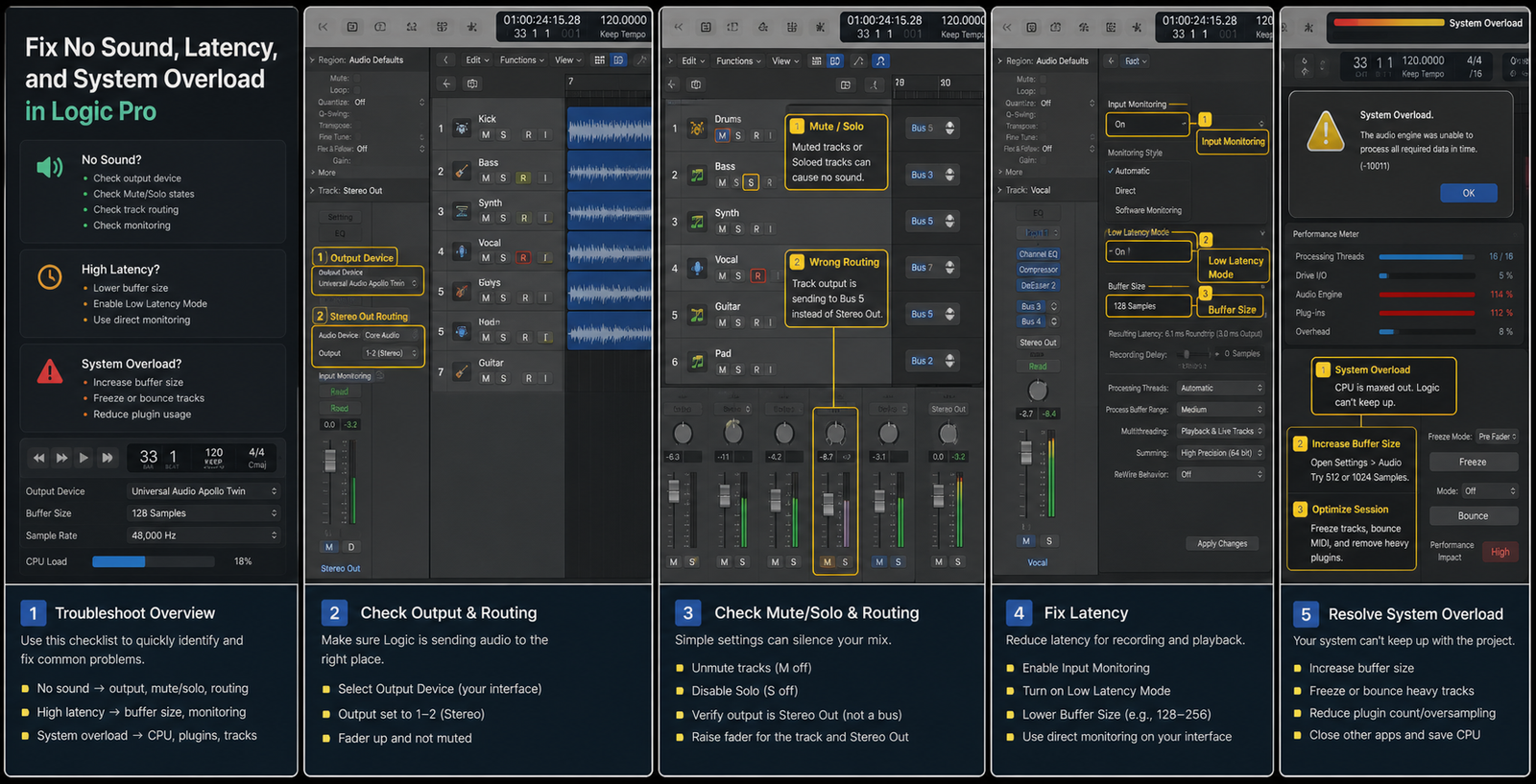
Quick answer
If you are in Logic Pro right now, do not start by opening every menu. Save the project before changing settings. Turn off solo and mute states you do not understand. Then move through the four checks below in order.
The order matters because troubleshooting work usually breaks earlier than it looks. A wrong track, region, input, bus, or range can make the last setting look guilty when it is only receiving a bad setup.
Use this as the short version before reading the full guide.
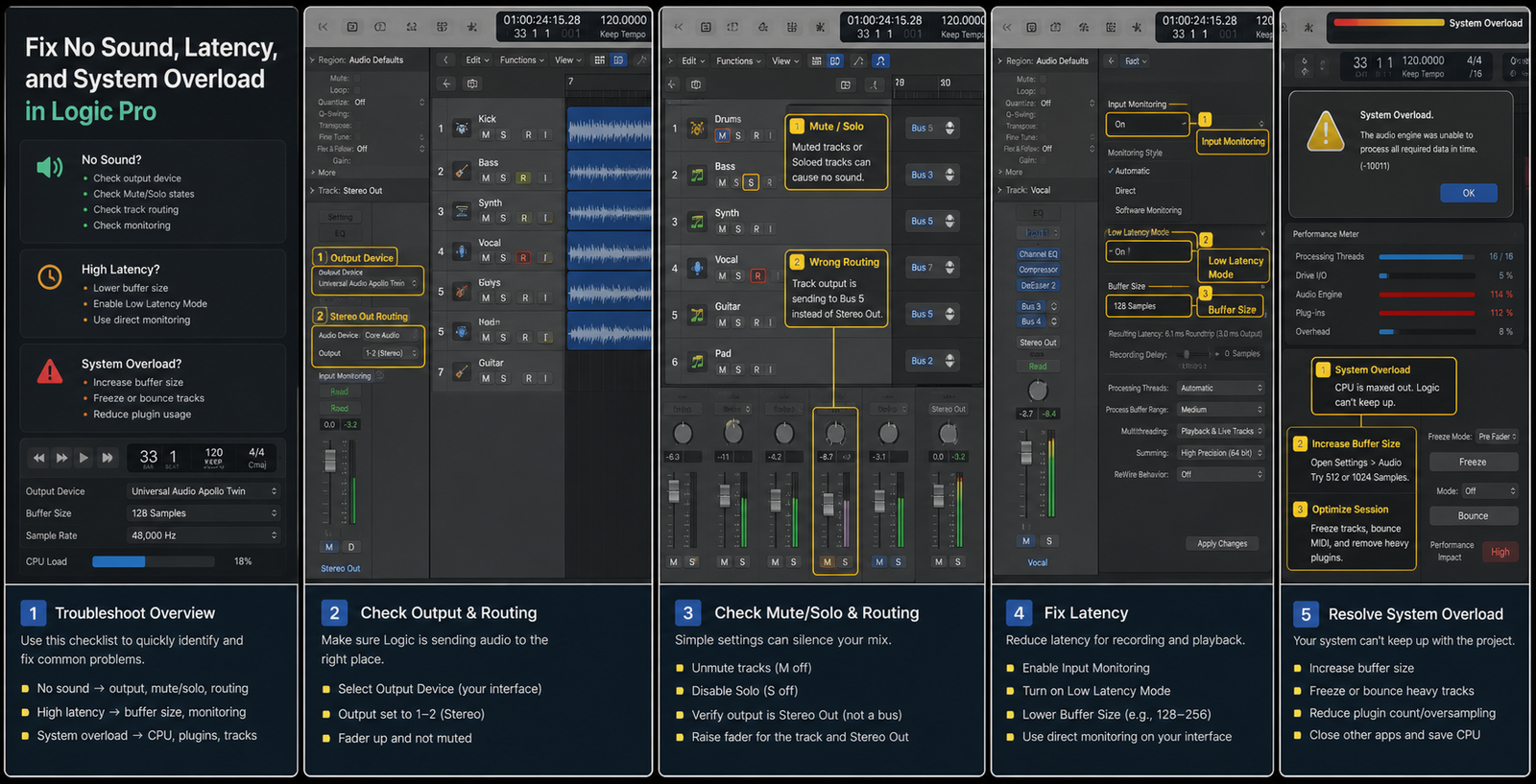
- Check output first: Make sure Logic is sending audio to the device you are hearing.
- Clear mute, solo, and routing mistakes: A single soloed track, muted aux, or wrong bus can silence a project.
- Fix monitoring delay: If recording feels late, lower the buffer, bypass heavy plugins, or use direct monitoring.
- Handle overloads methodically: Raise buffer size for mixing, freeze heavy tracks, bypass oversampling plugins, and close other CPU-heavy apps.
Before you start
- Save the project before changing settings.
- Turn off solo and mute states you do not understand.
- Know whether you are listening through the Mac or an interface.
- Test with one simple audio track if the whole project is confusing.
A clean pass from start to finish
Run this as one clean pass, not as disconnected tricks. Begin with the first checkpoint: check output first. Then move to the second: clear mute, solo, and routing mistakes. Those two checks make the project readable before you make detailed changes.
After that, use the next two checkpoints as the decision stage: fix monitoring delay, then handle overloads methodically. This is where you stop guessing and let the screen show whether the sound, timing, routing, or edit is behaving the way the song needs.
If you change more than one thing at once, write down what you changed or save a new version. Logic Pro is fast enough that a session can go from fixed to confusing in under a minute. Small, named moves are easier to trust later.
1. Check output first
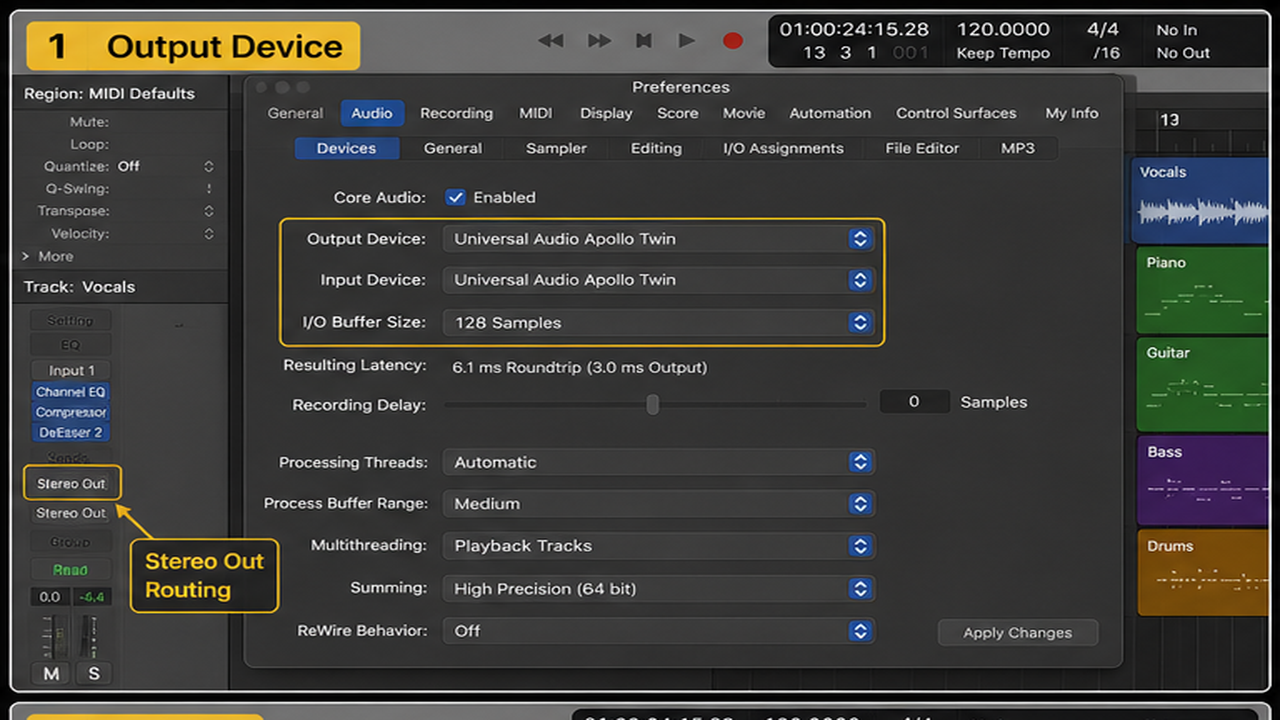
Make sure Logic is sending audio to the device you are hearing. Then check that the channel strip output goes to Stereo Out or the intended bus.
If meters move but you hear nothing, output routing is the first suspect.
2. Clear mute, solo, and routing mistakes
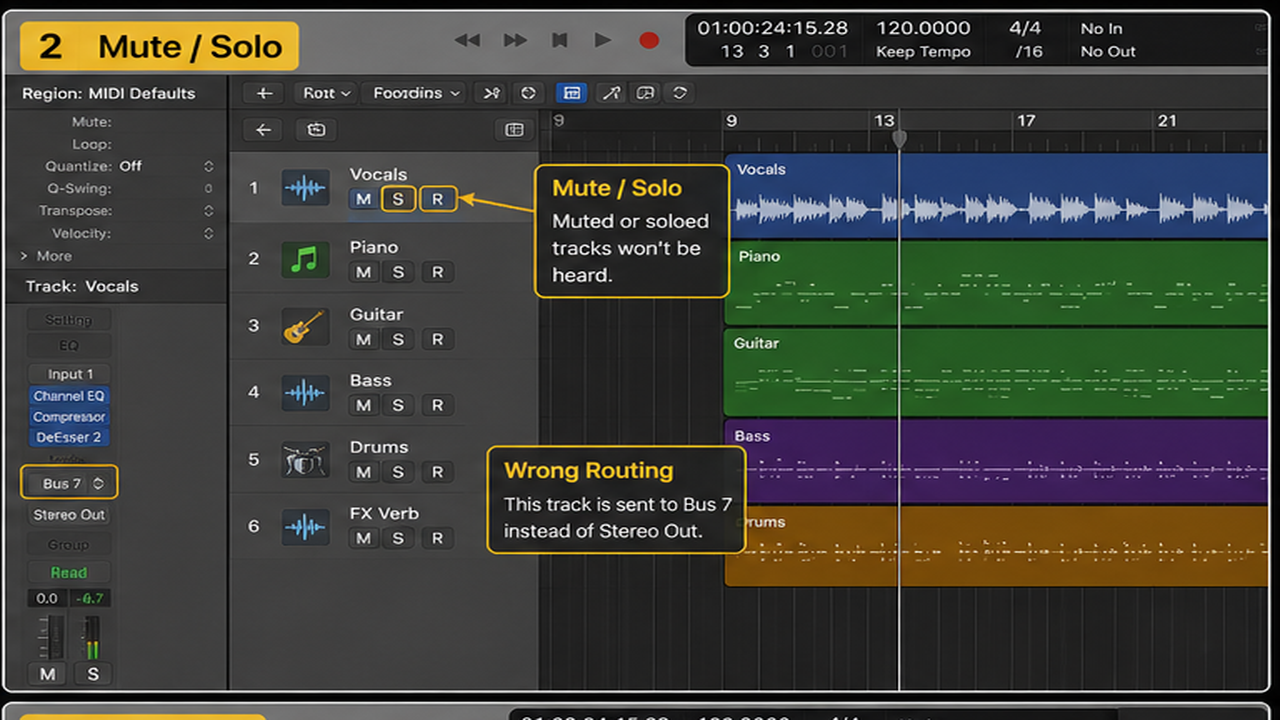
A single soloed track, muted aux, or wrong bus can silence a project. Check the track, aux returns, and master output before changing preferences.
Use the mixer because it shows the whole route more clearly than the arrangement.
3. Fix monitoring delay
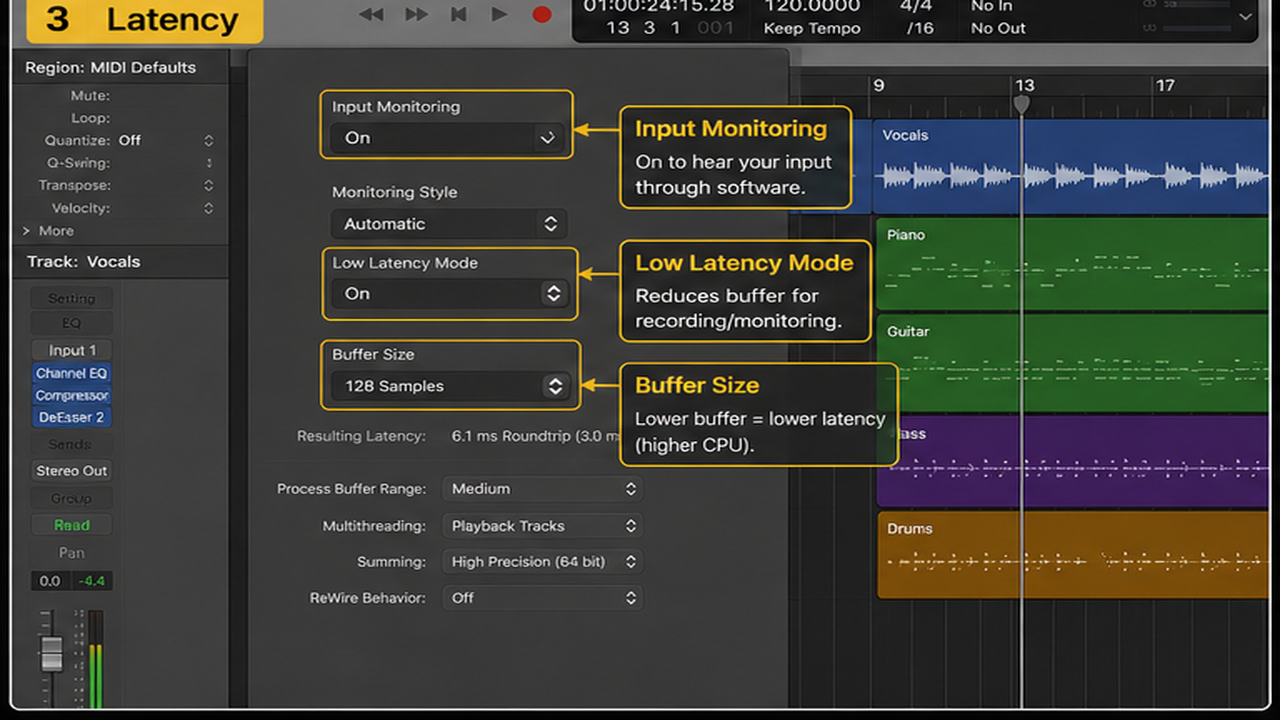
If recording feels late, lower the buffer, bypass heavy plugins, or use direct monitoring. Avoid hearing direct monitoring and Logic monitoring at the same time.
A doubled vocal usually means two monitoring paths are active.
4. Handle overloads methodically
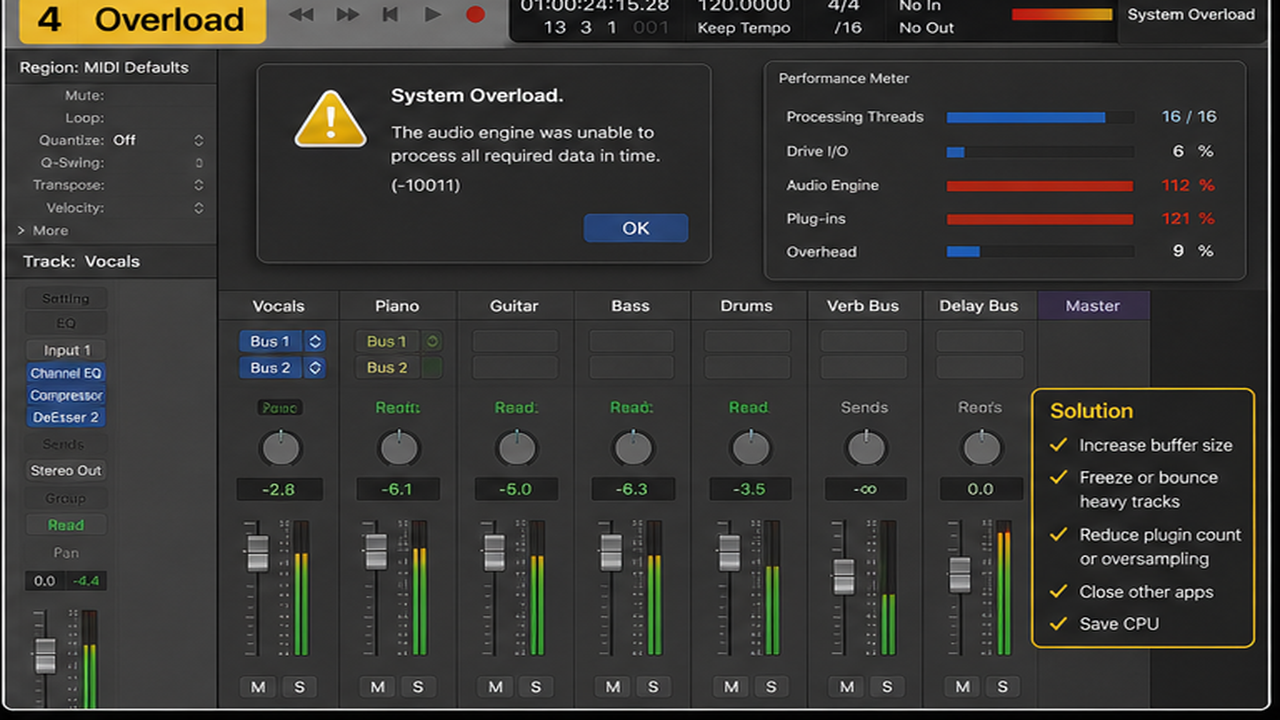
Raise buffer size for mixing, freeze heavy tracks, bypass oversampling plugins, and close other CPU-heavy apps. If one plugin causes the spike, solve that plugin rather than blaming the whole session.
Dense projects need mix settings; live recording needs tracking settings.
Decision table
| Problem | First check | Next move |
|---|---|---|
| No sound | Output device and Stereo Out | Check mute, solo, bus routing |
| Latency | Buffer and monitoring path | Use direct monitoring or Low Latency Mode |
| Crackles | Buffer and CPU | Raise buffer, freeze tracks |
| Overload | Heavy plugins | Bypass, freeze, or simplify |
Checkpoint table
| Checkpoint | What should be true | If it is not true |
|---|---|---|
| Check output first | If meters move but you hear nothing, output routing is the first suspect. | Back up and fix the setup before continuing. |
| Clear mute, solo, and routing mistakes | Use the mixer because it shows the whole route more clearly than the arrangement. | Do the smaller edit instead of rebuilding the whole part. |
| Fix monitoring delay | A doubled vocal usually means two monitoring paths are active. | Check what is selected, then repeat the change deliberately. |
| Handle overloads methodically | Dense projects need mix settings; live recording needs tracking settings. | Use the mixer or playback context as the final judge. |
Before and after check
Before the change, make one short playback pass and name the exact problem in plain words: late entrance, dull vocal, wrong input, harsh consonant, missing output, messy routing, clipped bounce, or whatever the session is actually doing. If you cannot name it, you are not ready to fix it yet.
After the change, play the same section at the same volume. Louder almost always sounds better for ten seconds, so level-match when you are judging troubleshooting decisions. The useful question is not whether the edit is impressive. It is whether the part sits better without pulling attention away from the song.
Check the edges of the fix. In Logic Pro, a repair can solve the center of a problem while damaging the bar before it, the breath after it, the bus return, or the export tail. A good before/after pass includes a little lead-in and a little space after the moment you changed.
If the after version only feels better while you are watching the screen, take a break and listen again without touching the mouse. Visual neatness is helpful for editing, but the final test is still playback. Keep the version that makes the project easier to finish.
What not to chase yet
Do not chase polish before the basic workflow is stable. For this topic, the first two checkpoints have to make sense before you worry about the smaller details: check output first, then clear mute, solo, and routing mistakes. Fancy settings cannot rescue a confused source.
Do not copy numbers blindly from another session. Buffer sizes, EQ points, quantize strength, compression timing, send levels, and bounce choices all depend on the material. Use examples as starting points, then move the control until this project sounds and behaves correctly.
Do not keep editing because the tool is available. Logic Pro gives you enough control to over-fix almost anything. Stop when the problem is gone and the performance still feels like a performance.
What good looks like
The troubleshooting workflow is working when you can explain what changed without pointing at a random plugin window. If the fix depends on luck, the session is not stable yet.
After the main pass, close the editor you were using and play the section from a few bars before the change. A good edit survives context. A bad edit only sounds correct when the screen is zoomed into the problem.
Keep one version before the major change and one version after it. Logic Pro projects can move quickly, and a clean fallback saves more time than trying to reverse a dozen tiny edits later.
If it still feels wrong
If the result still feels wrong, return to the signal chain. Ask whether the source is clean, whether the region edit is correct, whether the track is routed where you think it is, and whether the mixer confirms what your ears are telling you.
Do not add another processor just because the current one did not solve the issue. In Logic Pro, many problems are earlier than the plugin slot: wrong input, messy region boundaries, doubled monitoring, over-quantized MIDI, or a bus that is louder than the dry track.
When you get stuck, simplify the project. Mute everything except the source and the one track or aux it depends on. If the problem disappears, bring the session back one group at a time until the conflict shows itself.
Common mistakes to avoid
- Changing every preference before checking the output. Fix it by returning to the first visible control in the chain and confirming it before you touch a plugin.
- Recording through a heavy master chain. Fix it by listening to the section in context, then changing only the thing that fails the playback test.
- Using a low buffer for a dense mix. Fix it by saving a version, making the edit smaller, and checking whether the song still feels natural.
- Leaving both direct and software monitoring on. Fix it by simplifying the session view until the routing, region, or setting is obvious again.
Practice pass
Create a troubleshooting test project with one audio loop and one instrument. If the test project works, the problem is in the original session. If the test project fails, the problem is device, buffer, or system-level.
When to move on
You are done when the change helps the song at normal listening volume. Not when the screen looks tidy, not when every meter behaves perfectly, and not when the analyzer is pretty.
Print or bounce a short reference after the fix. Listening outside the edit screen catches problems that are invisible while you are staring at regions, lanes, and meters.
Sources checked
This draft was checked against current Apple Logic Pro documentation and release notes before writing. Source links used for version-sensitive claims on May 16, 2026:
- Apple guide to input monitoring latency
- Apple guide to avoiding system overloads
- Apple Logic Pro User Guide
FAQ
Why is there no sound in Logic Pro?
Common causes are wrong output device, wrong channel strip output, mute or solo state, inactive interface, or a silent software instrument track.
How do I reduce latency in Logic Pro?
Use a smaller buffer while recording, enable Low Latency Mode when needed, reduce heavy plugins, and consider direct monitoring.
Why does Logic Pro show system overload?
The project may be asking too much of the CPU or disk. Raise buffer size, freeze tracks, bypass heavy plugins, or simplify the session.
Why do I hear doubled vocals while recording?
You may be hearing both direct monitoring and Logic software monitoring. Pick one monitoring path.